Overview
Team 38’s entry in the 2025 Weir-Warman Design & Build Competition, a competition for engineering students across Australia and New Zealand, established by Engineers Australia. The task, Project SEESAW, was to build a robot no bigger than a 400 mm cube that, from a single start action, autonomously collects a tennis ball, a racquetball and a table-tennis ball from random spots in a 3×3 grid, crosses a pivoting seesaw, drops the balls in a deposit zone and parks in the end zone, all within 120 seconds.
I was one of five team members and worked mainly on the electrical system and the Arduino code.
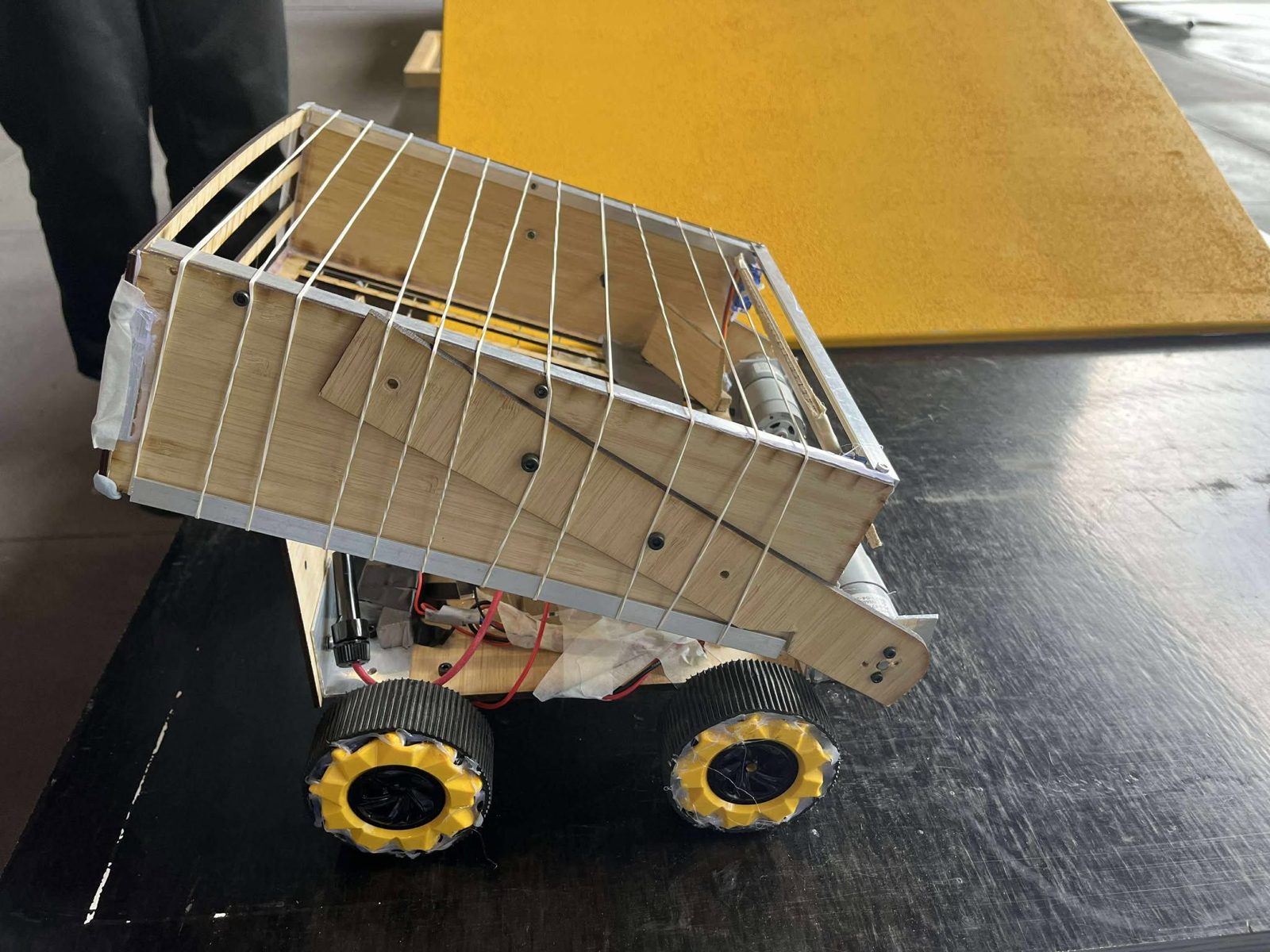
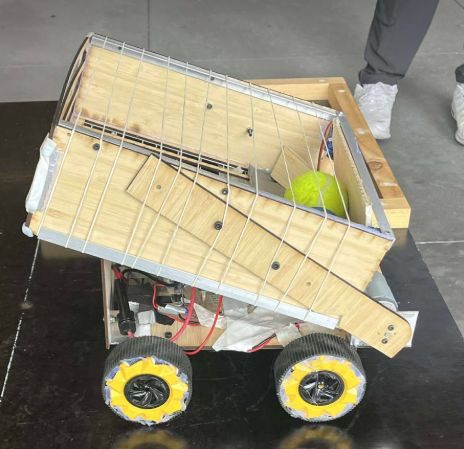
The robot
The team’s guiding principle was simplicity first. After abandoning an early claw-and-ramp concept, the final design had two parts:
- Body. Carries the Arduino, the LiPo battery, four motor-driven mecanum wheels and the arm motors.
- Collector. A lightweight laser-cut wooden box strung with rubber bands. It drops over the balls and scoops all three at once, with no sensors needed to find them. Servo-driven flaps release the balls at the deposit zone.
Electrical & software
The Arduino runs the whole mission as an autonomous sequence: drive to the balls, lower the collector, lift it, turn 90° onto the seesaw, cross it, turn 90° toward the deposit zone, open the flaps and finish in the end zone.
The hardest electrical problem was lifting the collector. A single arm motor couldn’t lift the box evenly, and we believed the Arduino didn’t have enough spare outputs to drive a second one. The fix was to wire the two arm motors in parallel, soldering their supply and ground together so both run in sync from one output. Combined with cutting weight out of the box, that lifted it reliably without needing another pin.
Result
In heat 2 the robot completed the full course in 59 s for a score of 210.5, with full marks for disturbance, movement, landing, deposit and end zone. It was one of the first teams to complete the mission. On competition day, though, the mecanum wheels lost traction on the seesaw and the run failed. Extra rear weight and glued-on rubber tread had fixed this in testing, but not reliably enough.
Main lesson: the team switched to the final design late, around week seven of ten, which left too little time to make it reliable. Committing earlier to the simpler concept would have bought that time.
Stack
Arduino (C++) · DC motors & servos · LiPo power · SOLIDWORKS · laser cutting